_
|
OUR
HISTORY |
| _ |
|
Boeing
C-17A Globemaster III |
|
|
 |
|
|
|
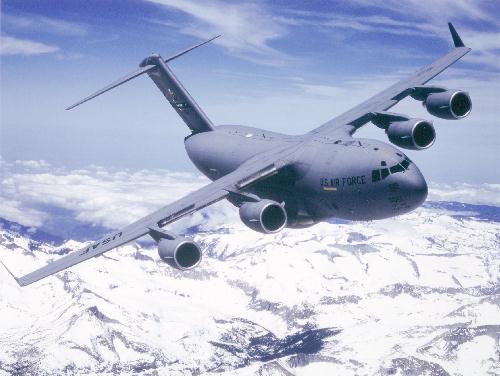
A
62d Airlift Wing C-17A from McChord Air Force Base is pictured banking over
Washington State Cascades Mountains.
|
|
|
|
|
 |
|
|
|
|
|
On July 30, 1999 hundreds of onlookers witnessed the
dawn of a new era for airlift in the Pacific Northwest
they saw the arrival of two of the most capable
airlifters ever made - the Boeing C-17A
Globemaster III. McChord received 52 of the very capable
planes as a replacement for it's retired workhorse
C-141B StarLifter.
The C-17 Globemaster III is the newest, most flexible
cargo aircraft to enter the airlift force. The C-17 is
capable of rapid strategic delivery of troops and all
types of cargo to main operating bases or directly to
forward bases in the deployment area. The aircraft is
also capable of performing tactical airlift and airdrop
missions when required. The inherent flexibility and
performance of the C-17 force improve the ability of the
total airlift system to fulfill the worldwide air
mobility requirements of the United States. The design
of the aircraft allows it to operate through small,
austere airfields. The C-17 can take off and land on
runways as short as 3,000 feet (914 meters) and only 90
feet wide (27.4 meters). Even on such narrow runways,
the C-17 can turn around using a three-point star turn
and its backing capability.
By the late 70's ,the US Air Force began to have issues with its airlift
fleet, C-141 StarLifter's and older model C-5's began to
show their age. Compounding matters, USAF historically
never possessed sufficient strategic airlift
capabilities to fulfill its airlift requirements, the
search for a new airlifter began. By October 1980, the
USAF set mission requirements and released a request for
proposals (RFP)
and initiated the Cargo-Experimental (C-X) competition to identify
a new jet-powered strategic airlifter.
Two companies, Boeing and McDonnell Douglas used larger
versions of aircraft developed
to replace the Lockheed C-130 Hercules developed during
the Advanced
Medium STOL Transport (AMST)
project that was canceled in 1979. Boeing bid an
enlarged version of its AMST YC-14. Lockheed submitted a
C-5 based design and an enlarged C-141 design. McDonnell
Douglas was selected to build its proposed aircraft on
28 August 1981, designated C-17.***Development continued
until December 1985 when a full-scale production
contract was signed for 210 aircraft. Development
problems and limited funding caused delays in the late
1980s. Questions were also raised about more
cost-effective alternatives during this time. In April
1990, Defense Secretary Dick Cheney reduced the order
from 210 to 120 aircraft.
The first C-17 (S/N 87-0025) made its maiden flight on
Sept. 15, 1991,the flight lasted for more than two hours
from the Douglas Long Beach Plant to Edwards Air Force
Base to begin the developmental flight-test program.
After initial testing, C-17's began entering its
operational service with the 437th Airlift Wing, at
Charleston Air Force Base, S.C. on June 14, 1993. The
first squadron of C-17s, the 17th Airlift Squadron, was
declared operationally ready Jan. 17, 1995.
The Air Force originally programmed to buy a total of
120 C-17s, with the last one being delivered in November
2004. The fiscal 2000 budget funded an additional 14
C-17s to give AMC the ability to configure 14 existing
C-17's for special operations duties replacing C-141
Special Operations Low Level (SOLL) II. Delivery of the
original 120 C-17s occurred between 1992 and 2004 at
Charleston AFB; McChord AFB, Altus AFB,
and 172nd AW,
Mississippi ANG. Basing of the additional 13 aircraft
was accomplished at McGuire AFB, NJ between 2004 & 2005.
During late 2000, Secretary of the Air Force F. Whitten
Peters considered dealing the planned 2006 retirement of
63 ANG and AFRES C-141s to 2010. This delay would solve
a shortage of "tails" since the C-141's were not being
replaced one of one with C-17's. (in other words 134
C-17s can only be in half as many locations as 270
C-141s). In 2002 Air Mobility Command officials released
a long-range airlift plan called the Mobility Roadmap,
which calls for up to 60 additional C-17's to eliminate
shortfalls in airlift capability. Boeing (which merged
with McDonnell Douglas in 1997) responded by proposing a
follow-on multiyear procurement under which 60 C-17s
would be bought at a rate of 15 per year and $152
million per plane (in FY ‘99 dollars, the current
average price is about $198 million in FY ‘99 dollars).
The additional aircraft would have extended range fuel
tanks and a maximum gross takeoff weight of 615,000
pounds, compared to 585,000 pounds on current aircraft.
In May 2002 The USAF was given the green light purchase
an additional 60 aircraft under contract with
Boeing worth as much as $10 billion, with production
extending through 2007. This contract would bring total
production to 180 aircraft replacing aircraft in use at
stateside active squadrons and will also be replacing
C-130's in Alaska and Hawaii.
In 2005, AMC
officials were faced with the potential retirement of a
number of older C-5 Galaxy airlifters, because of this
the Department of Defense considered an additional buy
42 aircraft worth about $5 billion. The aircraft could
have extend production of the C-17 through 2011,
resulting in a total buy of 222 aircraft.
In Fiscal Year
2007 National Defense Authorization Act Signed by
President George Bush set
aside $4.4 billion for 22 C-17, unfortunately 10 were
only funded for construction, which brought the
total buy for the USAF to 190 aircraft. Additional
C-17's to the USAF contract for FY2008 (15 aircraft)
FY2009 (8 aircraft) and FY2010 (10 aircraft) Defense
budgets raising the USAF total to 223 aircraft.
The
President's Fiscal 2011 Defense Budget request grows a department
fighting two wars and attacking an amorphous terror network, In
his February 2, 2010,
testimony in front of the Senate Armed Services Committee Defense
Secretary Robert M. Gates expressed to the Senators that he will
recommend President Barack Obama veto the 2011 budget if it
contains continued C-17 Globemaster III production. At the end of
2010, the USAF took delivery of the services 206th C-17.
In Fiscal Year
2011, 10 C-5 Galaxy aircraft will be replaced by 8 C-17s at
the U.S. Air Force Reserve Command's 445th Airlift Wing at
Wright-Patterson AFB, OH.
The first four C-17s
will arrive in fiscal 2011 after five of the C-5s are retired from
service. Four more C-17s will be delivered in FY 2012 after the
remaining C-5s are retired.
On November 17, 2010, the USAF selected the New York Air
National Guard 's 105th Airlift Wing at Stewart Air National Guard
Base as its "preferred base" for eight C-17's. The 12 C-5A Galaxy
operated by the 105th AW would be retired and replaced by the
C-17s. Air Force officials said the final decision on basing C-17s
at Stewart ANG Base will be made when an environmental impact
analysis is complete. This is expected to be complete by May of
2011. If selected, C-17's would begin moving to the base in the
fall of 2011.
USAF C-17's are
based as follows:
Air Mobility
Command - 62nd Airlift Wing and 446th Airlift Wing
(Associate Reserve) at McChord AFB; 437th Airlift
Wing and 315th Airlift Wing (Associate Reserve),
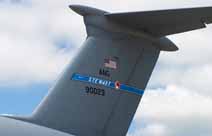
Charleston AFB, SC; the 305th Air Mobility Wing at
McGuire AFB, NJ, the 60th Air Mobility Wing and the
349th Air Mobility Wing (Associate Reserve) at Travis
AFB, CA and the 436th Airlift Wing and 512th AW
(Associate Reserve) at Dover AFB, DE.
Air National
Guard - 172nd AW Mississippi ANG at Allen C. Thompson Field,
105th Airlift Wing Stewart ANGB, NY (2012)
Air Force
Reserve Command -
452nd Air Mobility
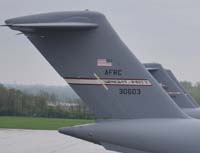
Wing at March Air Reserve Base, CA and 445th Airlift Wing
at Wright-Patterson AFB, OH
Pacific Air Forces - 15th Airlift Wing and 154th
Wing (Associate Guard) Hickam AFB, Hawaii and 3rd
Wing and 176th Wing (Associate Guard) at
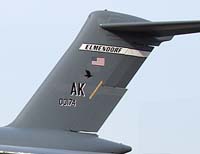
Elmendorf AFB, AK
Air Education & Training Command - 977th Air
Mobility Wing, Altus AFB, OK
Air Force Materiel Command - 412th Test Wing
at Edwards AFB, CA.
|
|
|
|
|
|
|
|
INTERNATIONAL OPERATORS |
|
|
|
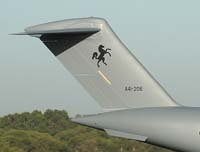
UNITED KINGDOM |
|
|
|
Boeing has actively marketed the C-17
to many European nations including Belgium, Britain,
France and Spain. The UK's 1998 Strategic Defense Review
identified a requirement for a strategic airlifter
following the protracted procurement of the European
airlifter, the Airbus A400M airlifter. The Short-Term
Strategic Airlift (STSA) competition began in September
of that year. The UK cancelled the competition in August
1999 recognizing that the C-17 met all of its demanding
specifications. In May 2000 British Ministry of Defense
announced that the RAF would lease four C-17s from
Boeing for an initial seven years with an optional two
year extension, with the option to buy the aircraft or
return them to Boeing at the end of the lease.
On May 23, 2001 at a ceremony at
Boeings Long Beach factory the RAF's took deliver of its
first of four Globemaster (ZZ171, the 77th C-17) with
the last of the 4 leased aircraft being delivered in
August of that year. All RAF C-17's are based at RAF
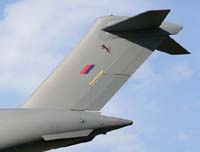
Brize Norton with the 99th Squadron.
Instead of extending the lease, In
2006 the RAF agreed to buy all 4 aircraft at the end of
the lease, with the outright purchase of one aircraft.
RAF concerns about late A400M delivery, and front-line
operational needs, have led the addition of a 3
additional
aircraft, the 5th and 6th aircraft entered service in
2008 the 7th in 2010.
|
|
|
|
|
|
AUSTRALIA |
|
|
|
On April 3, 2006,
the Defense Security Cooperation Agency notified Congress of
Foreign Military Sale to Australia of up to four C-17's aircraft,
18 Pratt & Whitney F117-PW-100 engines, parts and associated
equipment and services. The 4 C-17 Globemaster IIIs to the Royal
Australian Air Force ($195 million per plane) would be taken out
of C-17 construction positions from the Air Force Multi-Year
Procurement II (MYPII) C-17 production. Negotiations were between
Boeing the Australian and US Governments, completed in July 2006,
with the 1st delivery in November 2006; 2nd, May 2007; 3rd,
January 2008 and 4th, February 2008. RAAF C-17s fly with the 36th
Squadron at RAAF Base Amberley.
|
|
|
|
|
|
CANADA |
|
|
|
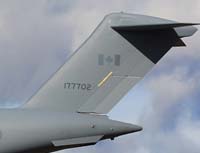
On Feb. 02, 2007,
Boeing and the Canadian government signed an agreement for
the purchase of four C-17 Globemaster IIIs for Canada's
Department of National Defense to provide new strategic
airlift mobility capabilities not currently available to the
Canadian Air Force. Boeing delivered the CAFs first CC-177
(C-17s Canadian designation) on August 8, 2007 arriving at
the 3rd Wing Bagotville, Quebec (for operational testing) on
Aug 21, 2007. Days later,
the
Canadian C-17 performed its
first operational mission delivering more than 35 tons of
aid to Kingston, Jamaica in the wake of Hurricane Dean.
Normally a mission of this type would have required 2-4
CC-130 (C-130) Hercules. The forth CC-177 was delivered on
April 1, 2008.
Canadian
C-17 are flown by the 429 Transport Squadron (“Bisons”)
based at 8 Wing / CFB Trenton.
|
|
|
|
|
|
NATO |
|
|
|
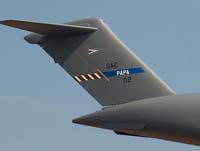
To address
the lack of heavy airlift capabilities in Europe, the NATO
Airlift Management Agency (NAMA) general manager, on behalf
of the Strategic Airlift Capability (SAC) nations, signed a
Letter of Offer and Acceptance with the U.S. government for
the acquisition of 2 C-17 Globemaster III. The On November
24, 2008 agreement follows NATO's Oct. 1 announcement that
the 12 SAC nations had formally agreed to move forward with
the acquisition of C-17s, which will address national
requirements for strategic airlift.
Under an
agreement with the U.S. Department of Defense and NAMA, 2 C-17s
would be purchased from Boeing, while a third would be provided by
the USAF. The aircraft would be assigned to SAC's Heavy Airlift
Wing and jointly operated by the nations from Pápa Air Base,
Hungary. Each participating nation would pay for a portion of a
C-17, giving each country a
share
in a pooled fleet. The 12 nations participating in the SAC Program
are Bulgaria, Estonia, Finland, Hungary, Lithuania, the
Netherlands, Norway, Poland, Romania, Slovenia, Sweden and the
United States
|
|
|
|
|
|
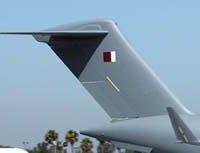
QATAR |
|
|
|
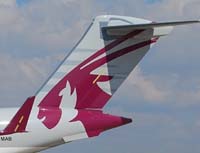
The government of Qatar signed an agreement with
Boeing on July 21, 2008 for the purchase of 2 C-17s
to provide new strategic-airlift mobility capabilities
for the Qatar Armed Forces (QAF). Boeing
delivered Qatar's first C-17 on August 11, 2009 and the
second on September 10, 2009.
"The QAF is very pleased to be acquiring C-17s," said
H.E. Maj. Gen. Hamad bin Ali Al-Attiyah, chief of staff,
Qatar Armed Forces. "The C-17 Globemaster III is a
world-class strategic and tactical airlifter that has
proven itself repeatedly around the world. This
agreement marks a new era in Qatar's ability to provide
strategic airlift in support of our military and
humanitarian operations."
"The QAF closely evaluated the available options for
airborne strategic lift and determined the C-17 best fit
the requirements for the State of Qatar," said Staff
Brig. Gen. Ahmad Al-Malki, head of Qatar's airlift
selection committee. "The aircraft forms the core of the
nation's strategic airborne lift capability."
|
|
|
|
|
|
United Arab
Emirates |
|
|
|
In Jan 2010 The United Arab Emirates announced a plan to
procure six C-17 airlifters over the Airbus A400M.
"The C-17 will give the UAE the ability to perform a
variety of humanitarian and strategic lift operations
around the world in support of both national and
international missions," said Major General Staff Pilot
Faris Mohamed Al Mazrouei. "These missions require us to
be ready for any contingency at any time and any place,
and the C-17 meets our requirements."
The Pentagon says the UAE
is considering use of the airlifters not just for
regional transport, but also “to support U.S. and NATO
airlift requirements in Afghanistan.” The UAE military
already has been quietly supporting Afghanistan
operations, having deployed unmanned aircraft to Helmand
province to provide additional intelligence,
surveillance and reconnaissance capacity to the
International Security Assistance Force.
The key attribute of the C-17 ahead of the A400M is its
ability to reverse down a runway where a turning circle
doesn’t exist – the A400M cannot match this unique
feature and will remain averse to operating into such
theatres when it’s finally delivered.
Under the agreement, the UAE will take delivery of four C-17s in 2011 and two in
2012.
|
|
|
|
|
|
INDIA |
|
|
|
In
June 2009, the
Indian Air Force (IAF) selected the C-17 to fulfill its
Very Heavy Lift Transport
Aircraft
requirement. If approved by the Indian Defense Ministry,
the C-17 would replace the Ilyushin
Il-76 as the IAF's largest heavy lift transport aircraft
in service. In January 2010, the US Government received
a request from India for 10 C-17s through the US
Government's Foreign Military Sales program,
and was approved by US Congress in June 2010. Signing of
a contract for the sale is pending.
On 23 June, the
Indian Air Force successfully test-landed a USAF C-17 at
the Gaggal Airport, India. This completed the IAF's C-17
trials. In August 2010, it was reported that the IAF is
seeking to order a total of 16 C-17s.
|
|
|
|
|
|
|
|
SPECIFICATIONS |
|
|
 |
|
|
|
|
·
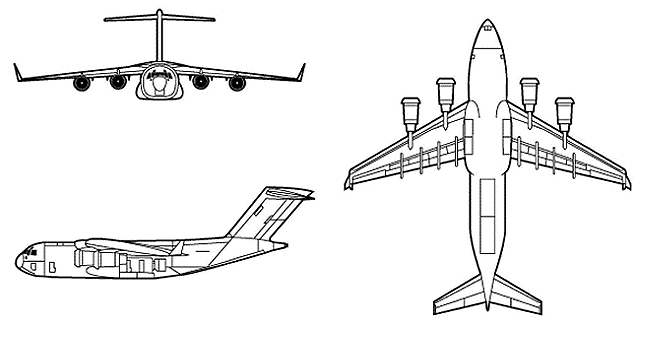
TYPE: Strategic troop / cargo transport
|
·
POWER: Four Pratt & Whitney F117-PW-100
turbofan engines, each 40,440 lbs thrust
|
·
SPEED:
Maximum speed 570 mph.
|
·
RANGE: Unlimited with in-flight refueling, Empty - (C-17) 5,294 mi,
(C-17ER) 7,135 mi Maximum
payload - (Both) 2,785 mi
|
·
MAXIMUM T.O. WEIGHT:
585,000 lbs
|
·
DIMENSIONS:
Span 169 ft 10 in , Length
174 ft Height
55 ft 1 in
|
·
CARGO COMPARTMENT DIMENSIONS
: Height
12ft 4 in, Length 88 ft, Width 18 ft;
|
·
CREW: Three; Two Pilots, one Loadmaster.
|
·
PRODUCTION TOTALS:
(Planned) 242 (C-17A)
|
·
UNIT COST: $236.7 million dollars
|
·
McCHORD
BASED UNITS:
|
|
Air Mobility Command
|
|
62d
AW ; 4th AS (2002- ), 7th
AS (1999- ), 8th AS
(2001- ), 10 AS
(2003- )
|
|
|
|
|
|
Air
Force Reserve / Air Force Reserve Command
|
|
446thAW; 97th
AS (2002- ),
313d AS (2001- ), 728th AS
(1999- )
|
|
|
|
|
|
|
|
"THE
SPIRIT OF McCHORD" |
|
|
|
|
 |
|
PHOTO BY ERNEST WHITE |
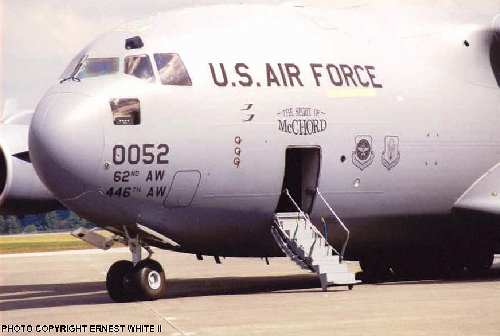
The
newest addition to the Museum collection - - - - - well some
day in the future McChord's first C-17A might be displayed along
side McChord's first C-141 s/n -0277. The C-17 in this picture,
s/n - 0052 is seen here minutes after its arrival to McChord on
July 30, 1999.
|
|
|
|
|
|
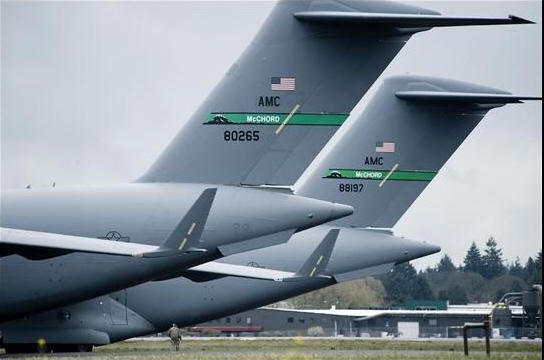
McCHORD
BASED C-17 GLOBEMASTER's |
|
|
|
|
 |
|
|
On
July 30, 1999
the 62d & 446th Airlift Wing's began receiving their first of a
new fleet of C-17's to replace its C-141 StarLifters. Since
then, McChord has been home for a total of 71 individual aircraft, 49 of those
delivered straight from
Boeing's Long Beach factory. When deliveries are complete a
total of 52 C-17 will be based at McChord.
Below you will find
listings of the many C-17's assigned to McChord, some of which
have moved on to serve with other units at other Air Force
Bases. Click the
links below to get additional information about McChord's C-17
inventory.
|
|
Current McChord based C-17 inventory |
|
McChord's Factory delivered C-17's
|
|
C-17's transferred
to McChord |
|
C-17's transferred
from McChord |
|
|
|
|
|
|
 |
|
|
|
|
|
|
|
CHRISTENED
USAF
C-17A |
|
|
|
Click the
links below to get additional information about McChord's C-17
inventory. |
|
|
|
Named USAF C-17A Globemasters |
|
"Lets Roll" Nose Art Aircraft |
|
|
|
|
|
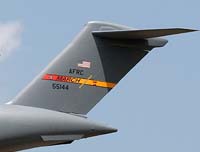
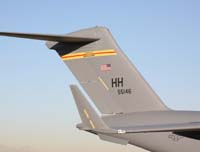
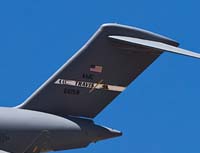
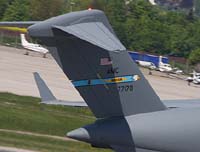
GLOBEMASTER
TAILS |
|
|
| (Click
images below for additional pictures and unit information) |
|
|
|
U.S. AIR FORCE UNITS |
|
(IN ORDER OF ACTIVATION) |
|
|
|
 |
 |
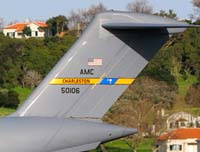
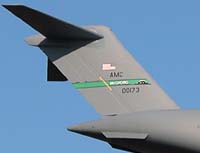
| 412th Test Wing (AFMC) |
97th
Air Mobility Wing (AETC) |
| |
|
|
 |
 |
437th Airlift Wing (AMC)
315th Airlift Wing (AFRC) |
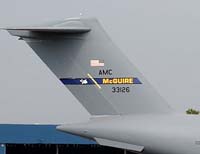
62nd
Airlift Wing (AMC)
446th Airlift Wing (AFRC) |
|
|
|
|
|
 |
|
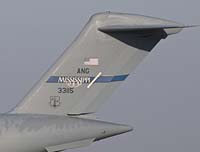
172nd Airlift Wing
(ANG)
|
305th
Air Mobility Wing (AMC)
514th Air Mobility Wing (AFRC) |
|
|
 |
 |
| 452nd
Air Mobility Wing (AFRC) |
15th
Airlift Wing (PACAF)
154th Wing (ANG) |
|
|
|
 |
 |
60th
Air Mobility Wing (AMC)
349th Air
Mobility Wing (AFRC) |
436th
Airlift Wing (AMC)
512th
Airlift Wing (AFRC) |
|
|
|
 |
 |
3rd
Wing (PACAF)
176th Wing (ANG) |
445th Airlift Wing (AFRC) |
|
|
 |
|
105th Airlift Wing (ANG) |
|
(2012) |
|
|
|
INTERNATIONAL OPERATORS |
|
|
 |
 |
|
No. 99th Squadron
(RAF)
|
No.
36th Squadron (RAAF) |
|
|
|
 |
 |
| 8th
Wing (CAF) |
NATO/SAC |
|
|
|
 |
 |
|
Qatar Emiri Air Force |
United Arab Emirates (U.A.E) |
|
|
|
|
|
|
|
|
|
Website
provided and maintained by: |
|
|
|
McChord Air Museum Foundation |
| P.O.
Box 4205 |
| McChord
AFB, WA. 98438-0205 |
| 253-982-2485 |
|
e-mail
- mamfound@mcchordairmuseum.org |
|
|
|
|
|
|

|
|
|
|
|
|